
Official Name:
- EN: Panboron (Hainan) BNCT Hospital (Pengbo Hainan Boron Neutron Hospital)
- CN: 澎博(海南)硼中子医院
Country, City, Address: China, Hainan Province, Qionghai City, Boao International Medical Tourism Pilot Zone, Guangci Road, No. 6 (No. 6 Guangci Road, Boao International Medical Tourism Pilot Zone, Qionghai City, Hainan Province).
Year of Establishment:
- Founded in 2022 as a subsidiary of Hong Kong–listed China Biotech Services Holdings Limited.
- Trial operations began in early February 2026.
- First clinical treatment performed on March 19, 2026 — a patient with recurrent tongue cancer from Henan Province.
Type of Clinic: Specialized oncology hospital; the only facility in China licensed for clinical application of BNCT (Boron Neutron Capture Therapy). Total area: approximately 14,000 sq. m; investment: ~500 million CNY (~70 million USD).
Main Specializations:
- Boron Neutron Capture Therapy (BNCT) — the primary and exclusive focus.
- Inoperable, locally advanced, or recurrent head and neck cancers — current licensed indication.
- Multidisciplinary approach (MDT): radiation oncologists, surgeons, nuclear medicine specialists, and medical physicists.
Key Technologies:
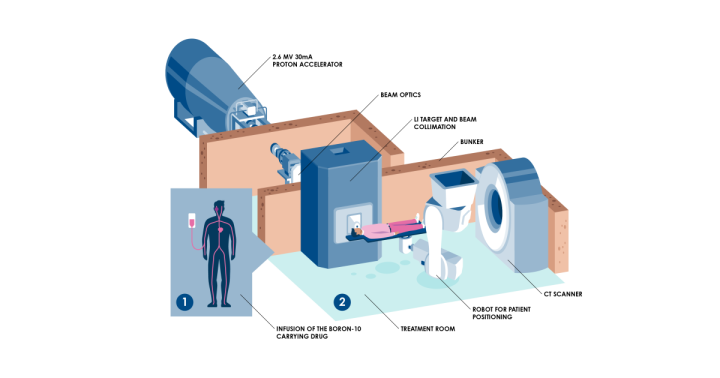
- NeuCure® — accelerator-based BNCT system by Sumitomo Heavy Industries (Japan). Features an AVF cyclotron with a 30 MeV proton beam, beam shaping assembly, and patient positioning system. One of the few BNCT systems worldwide with official regulatory approval (approved in Japan).
- Steboronine® (borofalan / BPA) — the only boron compound globally approved for clinical BNCT use (approved in Japan in 2020; included in national insurance).
- 18F-BPA PET/CT — imaging to assess boron uptake in the tumor prior to treatment; determines whether a patient is eligible for BNCT.
- Mechanism of Action: A boron-10 compound is administered to the patient; it selectively accumulates in cancer cells. The tumor area is then irradiated with epithermal neutrons. Boron captures a neutron and decays directly inside the cell, releasing alpha particles with a range of 5–9 µm (approximately one cell width). Healthy tissues remain largely unaffected.
- Treatment is often completed in a single irradiation session (~30–50 minutes), as opposed to weeks of daily procedures in conventional radiotherapy.
Conditions Treated:
| Status | Conditions |
|---|---|
| Licensed Indication | Inoperable, locally advanced, or recurrent head and neck cancer (nasopharyngeal, laryngeal, thyroid, oral cavity, tongue, ENT and neck tumors) |
| Expanding Indications | Recurrent brain tumors (glioblastoma, meningioma), melanoma (including metastases) |
| Investigational (Potential) | Liver cancer, breast cancer, lung cancer, sarcoma — in early-stage research |
Clinical Outcomes: At the 22nd Annual Meeting of the Japanese Society for Neutron Capture Therapy (JSNCT‑22, July 2026), the hospital presented data on the first 10 evaluable patients with head and neck tumors: ORR of 80% (complete response — 40%, partial response — 40%). All patients had inoperable or recurrent late-stage tumors unresponsive to chemotherapy and radiotherapy.
International Center: Yes. The hospital accepts patients from other countries (confirmed cases from 19 Chinese provinces and abroad). The Boao Lecheng zone operates under a special regulatory framework that allows the use of foreign-approved drugs and equipment prior to their nationwide Chinese registration.
Languages: Chinese (primary), English (available via the English-language website). No direct Russian-language service is listed on the official site; international patient coordination is handled through third-party platforms (e.g., CancerFax).
Doctors / Leading Specialists:
| Name | Position | Experience |
|---|---|---|
| Wang Enmin | President of the Hospital, Chief Physician of the BNCT Center | First specialist in China for Gamma Knife; former head of CyberKnife Center at Huashan Hospital (Fudan University). Trained in London and Pennsylvania. Over 6,000 patients treated with CyberKnife. |
| Liu Junyang | Vice President, Associate Researcher | MD from Niigata University (Japan); postdoctoral training at the Chinese Air Force Hospital. Recognized as a Hainan Province talent. |
| Chen Xianzhao | Chief Physician, Radiation Oncology | Founder of the first radiation therapy department in Hainan (1983). Over 10,000 treated patients. Member of the Radiation Oncology Committee of the Chinese Medical Association. |
| Zhu Fuhai | Chief Physicist, Head of Physics and Technology Team | 16 years in radiation physics; 24 publications, 5 monographs; co-author of 3 national radiotherapy quality control standards by the National Cancer Center. |
| Dr. Li Wei | Chief Oncologist | Cited in publications as the hospital’s lead oncologist. |
| Dr. Zhang Min | Lead Physicist | Cited in the publication about the first treatment. |
| Prof. Chen Hao | Head of Nuclear Medicine | Cited in publications. |
Equipment — Confirmed:
- NeuCure® — accelerator BNCT system (Sumitomo Heavy Industries, Japan): 30 MeV AVF cyclotron, beam shaping assembly, patient positioning system.
- Steboronine® (borofalan) — the world’s only approved boron agent for BNCT.
- 18F-BPA PET/CT — for pre-treatment assessment of tumor boron uptake.
- MRI and CT — for treatment planning and monitoring.
- Import cost of the equipment: ~150 million CNY (~21 million USD).
Photographs: Not included in this text; available on the official website.
Official Website: — English version.https://www.panboron.com/en

 Oncology